 CMP Slurry PROCESS MATERIALS REFERENCE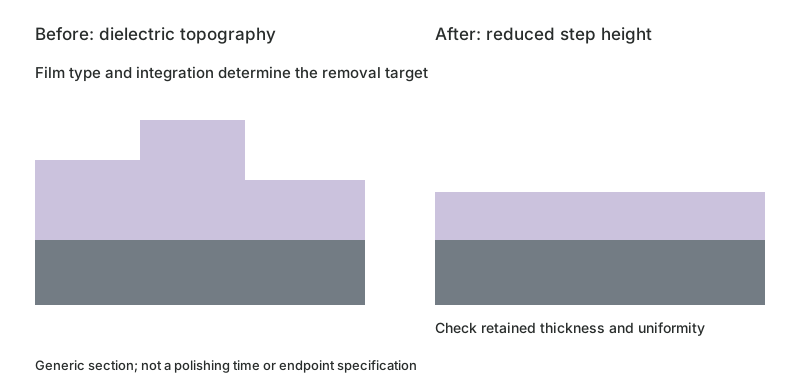
“Oxide” is a starting category, not a specification
Silicon dioxide can appear as a thermally grown or deposited film, with different deposition processes and treatments. Define the actual film and thermal history in the test plan. A slurry result on one oxide should not be silently transferred to another oxide or to a porous low-k dielectric.
State whether the task is interlayer dielectric planarization, clearing an overburden or stopping on a different film. STI has a more specific stop-layer and patterned-isolation context; it receives its own STI CMP guide.
| Process input | What to document | What it prevents |
|---|---|---|
| Film identity | Deposition type, relevant treatment and thickness range. | Comparing rates measured on unlike films. |
| Incoming topography | Step height and representative pattern families. | A blanket screen being mistaken for planarity evidence. |
| Exposed neighboring films | Nitride, polysilicon or other films actually present. | Specifying a ratio to an irrelevant stop material. |
| Endpoint / overpolish | Clearing logic and exposure after local clearing. | Ignoring local stop-film loss or pattern damage. |
Silica and ceria routes
Both ceria and nonceria abrasives are examined in oxide CMP research. Particle chemistry and functionalization are active design variables, so an abrasive label is insufficient to predict the result. Oxide abrasive review ↗
Ceria–silica interfacial bonding is discussed in abrasive research as part of oxide removal. This explains why the system cannot be understood from relative particle hardness alone. Interfacial abrasive chemistry ↗
The same interaction can increase the difficulty of removing ceria residue from an oxide surface. Select the polish and clean sequence together; do not assume a clean developed for a silica system transfers unchanged. Post-STI cleaning research ↗
Build a planarity and defect window
- Measure oxide removal on matched blanket wafers using a consistent thickness map.
- Measure patterned step-height reduction and loss in reference regions.
- Evaluate stop-film loss where a stopping layer is part of the integration.
- Vary endpoint or overpolish around the intended operating point.
- Classify scratches, particle residues and other defects after the selected clean.
- Repeat with representative prepared-slurry age and pad-life conditions.
Questions for an oxide supplier
FUJIMI’s public lineup identifies PLANERLITE 4000 as an oxide-film family. This is useful for finding an application contact, but a family listing does not disclose the candidate grade, film-rate balance or the buyer’s release limits. Product-family listing ↗
Ask which exact oxide films were used for the product data, how step-height reduction was measured, and which pad and cleaning sequence supported the result. Request the particle-distribution and impurity specifications at the supplied state, then agree what must be controlled at point of use. Confirm whether dilution changes only concentration or also the required preparation and use-life.
Sources & evidence
- Strategies for Enhancing SiO₂ CMP: Functional Nanoparticle Abrasive Design ↗Peer-reviewed review · Chemistry — A European Journal · 2025/2026. Publisher abstract indexed by PubMed: ceria and nonceria abrasive design for oxide CMP.
- A Comprehensive Review of the Nano-Abrasives Key Parameters Influencing Performance in CMP ↗Peer-reviewed review · Nanomaterials · 2025. Particle size, morphology, surface chemistry and ceria–silica interactions. Publisher page rate-limited during direct retrieval; indexed publisher excerpts reviewed.
- Effect of complexing agent on ceria particle removal in post-STI CMP cleaning ↗Peer-reviewed research · Colloids and Surfaces A · 2023. Ceria–oxide bonding and particle-removal challenges; public abstract reviewed.
- FUJIMI — CMP product line-up ↗Manufacturer primary source. PLANERLITE oxide, tungsten, polysilicon, copper and barrier product families.