 CMP Slurry PROCESS MATERIALS REFERENCE
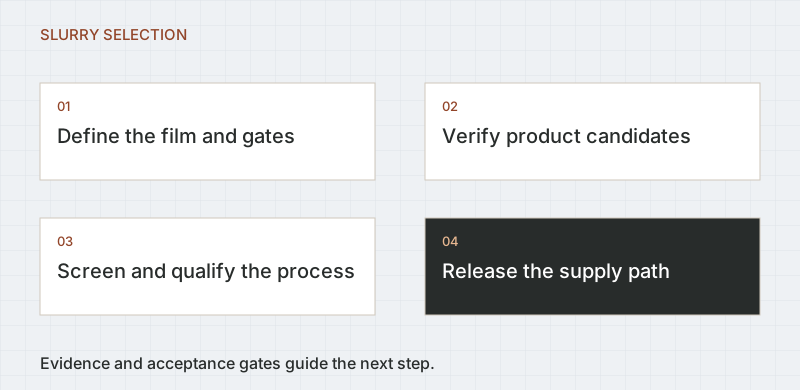
1. Translate the application into acceptance gates
Start with the target material, adjacent films, integration stage and limiting patterns. Specify what must be removed, what must remain and how those outcomes are measured. Desired removal rate is a throughput input; acceptable film loss, defects and surface quality define whether the process can be used.
| Requirement group | Inputs to define | Evidence for a decision |
|---|---|---|
| Application | Target / adjacent films, stage, incoming thickness and topography, wafer/platform. | A representative film stack and pattern population. |
| Performance | Rate, selectivity, uniformity, dishing, erosion, recess, defects, corrosion and roughness. | Buyer-defined limits and repeatable measurement methods. |
| Platform | Tool, pad, conditioner, flow, endpoint, filter and clean. | Compatibility on the actual process combination. |
| Product state | Supplied concentration, preparation, activation, water, storage and use-life. | Controlled point-of-use conditions with traceability. |
| Supplier / quality | Lots, COA, impurity control, change management, technical support and qualification support. | Documents and data rather than broad capability statements. |
| Commercial / continuity | Lead time, shelf life at receipt, logistics, backup path and cost basis. | A workable supply plan and normalized quote. |
2. Shortlist from verified product participation
Use the manufacturer directory to identify application categories with public primary-source support. Ask each candidate supplier to identify a grade for the requirement set. A directory match means the supplier publicly offers a relevant category; it does not mean the product is fab-qualified or available in the buying region.
- Send the same technical requirement set to each candidate.
- Request exact product identity and revision, supplied-state specifications and preparation instructions.
- Separate guaranteed limits, typical product data and development goals.
- Identify which supporting data use the buyer’s films, patterns, pad and clean.
- Record gaps that require trials or supplier clarification.
3. Screen chemistry and platform together
Perform matched target/adjacent-film screens, followed by patterned wafers and the intended clean. The wafer-interface literature describes why contact, chemistry and transport are coupled. Treat a supplier-specific pad and slurry combination as a package when that is what the trial evaluates. Interface review ↗
Use the evaluation matrix to retain rates, defects, metrology and conditions. Include static chemical loss for corrosion-sensitive metals, prepared-material age, pad life and filter behavior where relevant. Resolve the difference between a nominal operating point and a usable window.
4. Qualify repeatability and supplier controls
A successful trial does not establish sustained supply. Repeat the limiting responses across the lots, tools and operating conditions covered by the release plan. Require documented change notification for product, raw material, process, specification, package and manufacturing site changes when they can affect the qualified product.
Review supplier qualification in parallel with technical trials. Missing evidence on lot consistency, support or continuity can be a reason to defer a candidate even when wafer results are promising. Supplier system descriptions can orient the review, but actual controls must be confirmed. CMP system overview ↗
5. Normalize economics after feasibility
Lowest price per liter does not necessarily give the lowest cost per wafer or the lowest total process cost. Normalize supplied concentration, preparation yield, slurry consumption, polish time, filtration, clean and waste. Keep qualification and change costs visible.
Compare candidates using the same operating assumptions and separate recurring cost from one-time transition work. The cost framework explains a transparent model without inventing commercial prices.
Use the comparison matrix CSV ↓Prepare a consistent RFQ CSV ↓6. Release a defined process, with open items visible
- Identify the product and approved manufacturing / supply path.
- Name the qualified preparation, tool, pad, filter and cleaning conditions.
- State the wafer populations and process-window range covered.
- Assign owners for monitoring, deviations and supplier communication.
- Close mandatory documentation and quality conditions.
- Keep untested assumptions and follow-up work outside the release claim.
This framework organizes a decision. It does not select a production formulation or replace a fab’s qualification and release procedures.
Sources & evidence
- Seo — Chemical and mechanical phenomena at the wafer interface ↗Peer-reviewed review · Journal of Materials Research · 2021. Contact mechanics, lubrication, electrochemistry, adsorption and limits of simple removal models.
- Entegris — Chemical Mechanical Planarization ↗Supplier portfolio / system overview. Slurries, pads, filters, process monitoring and post-CMP cleaning.