 CMP Slurry PROCESS MATERIALS REFERENCE
What the pad contributes
The pad supports contact, distributes liquid and responds mechanically to the wafer topography. Slurry supplies the chemical environment and, in conventional systems, particles. The combined response is governed by both consumables and process conditions. CMP system fundamentals ↗
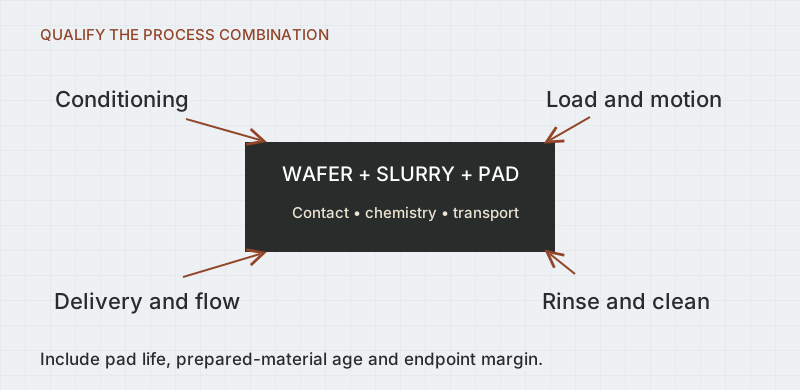
Entegris’s current CMP overview includes pads, slurry, filtration, monitoring and cleaning in the same portfolio. That reinforces the range of variables to examine, while any claimed supplier synergy still requires application-specific validation. Supplier system overview ↗
Compatibility is more than a pad brand
| Variable | Record in every comparison | Question to resolve |
|---|---|---|
| Pad construction / condition | Product, lot where relevant, break-in and life state. | Is the response stable across the planned life range? |
| Conditioning | Disk, settings, timing and wear history. | Is texture being maintained without excess debris? |
| Pressure / carrier | Pressure zones and retaining-ring configuration. | Are changes in contact causing rate or uniformity drift? |
| Relative motion | Platen/carrier settings and process stage. | Is the compared exposure genuinely matched? |
| Slurry flow / delivery | Flow, nozzle, preparation and recirculation. | Is supply to the interface consistent? |
| Temperature | Relevant tool or process-temperature record. | Does warm-up or thermal drift change the response? |
| Wafer / endpoint | Film, incoming topography and clearing logic. | Does the trial cover the integration’s limiting patterns? |
| Cleaning | Rinse, brush, chemical and dry sequence. | Can the resulting surface be cleaned within the platform? |
Conditioning and flow deserve their own controls
Pad-conditioning research examines surface renewal as part of retaining a usable removal response. Slurry-flow studies investigate the influence of pad grooves and transport. Neither supports assuming that the same liquid performs identically on every pad or delivery configuration. Conditioning study ↗ Slurry-flow study ↗
When comparing products, either hold the pad/conditioning protocol constant or declare a package comparison. The second approach can be commercially useful, but the conclusion must say that the process combination was tested.
Temperature can also influence dishing behavior in studied processes. Record the thermal history when it is a plausible contributor to the result. Temperature study ↗
A practical compatibility trial
- Establish a baseline after the approved pad break-in.
- Measure rate, uniformity and classified defects at defined pad-life intervals.
- Include nominal operation and the agreed endpoint / overpolish window.
- Track filter and delivery changes rather than treating them as background.
- Evaluate particle and residue removal after the intended clean.
- Repeat the limiting conditions before declaring the combination released.
Sources & evidence
- Zhao & Lu — Chemical mechanical polishing: Theory and experiment ↗Peer-reviewed review · Friction · 2013. Chemical–mechanical synergy and the roles of the carrier, pad, slurry and operating conditions.
- Contact-Area-Changeable CMP Conditioning for Enhancing Pad Lifetime ↗Peer-reviewed research · Applied Sciences · 2021. Pad surface renewal and conditioning. Indexed publisher excerpts reviewed.
- Radial Groove Effect on Slurry Flow in Oxide CMP ↗Peer-reviewed simulation and experiment · Applied Sciences · 2022. Pad geometry and slurry transport. Indexed publisher excerpts reviewed.
- Process Temperature Control for Low Dishing in CMP ↗Peer-reviewed research · Materials · 2025. Temperature as a process variable in dishing control. Indexed publisher excerpts reviewed.
- Entegris — Chemical Mechanical Planarization ↗Supplier portfolio / system overview. Slurries, pads, filters, process monitoring and post-CMP cleaning.