 CMP Slurry PROCESS MATERIALS REFERENCE
Classify before changing the process
Start with the defect morphology, location, timing and affected material. A total defect count blends failure modes that may have different causes. Compare incoming, after-polish and after-clean observations where the measurement sequence is practical.
| Observation | Candidate causes to investigate | Useful separation test |
|---|---|---|
| Linear scratches | Large particles, pad/conditioner debris, hard contamination, contact conditions. | Inspect liquid and pad path; compare classified scratch signatures. |
| Particles / clusters | Agglomeration, delivery contamination, incomplete removal or re-deposition. | Sample along delivery; compare before and after cleaning. |
| Organic / chemical residues | Adsorbed additives, reaction products, inadequate clean compatibility. | Characterize residue with appropriate surface analysis. |
| Pits / localized attack | Chemical or electrochemical loss during polish, hold or clean. | Static/dynamic exposure screens with timing recorded. |
| Dishing | Feature-scale removal imbalance and contact/overpolish effects. | Profile feature-width families over an endpoint window. |
| Erosion | Pattern-density and multi-film removal response. | Compare dense/sparse regions and adjacent-film loss. |
| Surface damage / delamination | Film integrity, pressure/contact, stack or process integration. | Review incoming films and correlate damage with the process step. |
When the slurry hypothesis is plausible
Supplier particle-characterization material links abrasive agglomeration with scratch risk and emphasizes distribution-tail monitoring. This supports checking large-particle populations instead of relying on nominal size. It does not establish that any particular scratch came from the slurry. Particle-monitoring source ↗
Compare the same product at receipt, after preparation and near the tool. An excursion only after a pump, tank, filter or recirculation segment points to the delivery history. Retain lot and container identities; an otherwise unexplained drift should not be assigned to chemistry without evidence.
Pad, layout and chemistry can create similar symptoms
Conditioning research treats pad-surface renewal as part of sustained removal behavior. Inspect the pad, conditioner and pad-life state when scratches or rate drift appear. Pad-conditioning study ↗
For topography, layout and polish stage affect dishing and erosion. For chemical damage, static exposure and sliding can give different responses. Use those distinctions to choose a controlled test rather than swapping a consumable at random. Pattern dependence ↗ Dynamic corrosion evidence ↗
- Review pressure zones, speeds, retaining-ring behavior and endpoint settings.
- Check flow, air introduction, preparation and hold history.
- Inspect pad condition, conditioner wear and possible debris.
- Compare the wafer stack and pattern population with the qualification baseline.
- Verify rinse, clean, brushes, drying and queue time.
A troubleshooting sequence that preserves evidence
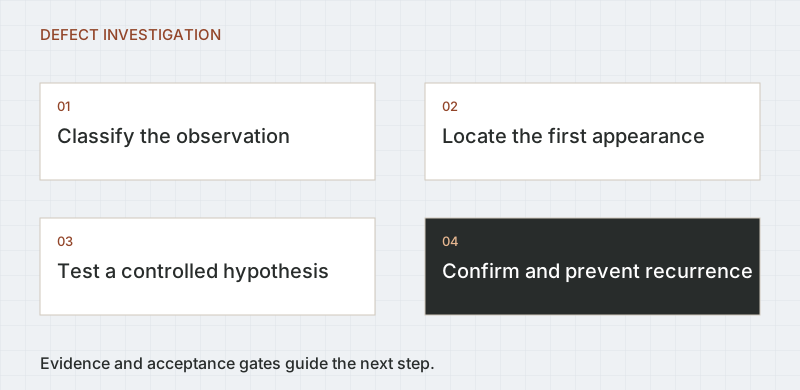
- Contain affected material and preserve samples, logs and raw inspection data.
- Classify defects and map their location on the wafer.
- Determine the earliest observable stage at which they appear.
- List hypotheses with the evidence that would support or reject each one.
- Run a controlled comparison with the metrology and wafer population held consistent.
- Confirm the correction across the affected operating range.
- Document the cause, scope, corrective action and prevention.
Sources & evidence
- Entegris — CMP slurry particle characterization ↗Supplier technical information. Large-particle monitoring and filtration characterization; instrument superiority claims are not adopted.
- Contact-Area-Changeable CMP Conditioning for Enhancing Pad Lifetime ↗Peer-reviewed research · Applied Sciences · 2021. Pad surface renewal and conditioning. Indexed publisher excerpts reviewed.
- Coverage Layout Design Rules and Insertion Utilities for CMP-Related Processes ↗Peer-reviewed research · Journal of Low Power Electronics and Applications · 2021. Pattern dependence and staged copper polishing. Indexed publisher excerpts reviewed.
- Corrosion mechanisms of Co and Cu: electrochemistry and triboelectrochemistry ↗Peer-reviewed research · Corrosion Science · 2026. Metal-specific inhibition and the difference between static and sliding conditions. Public abstract reviewed.