 CMP Slurry PROCESS MATERIALS REFERENCE
Define the copper step before defining the slurry
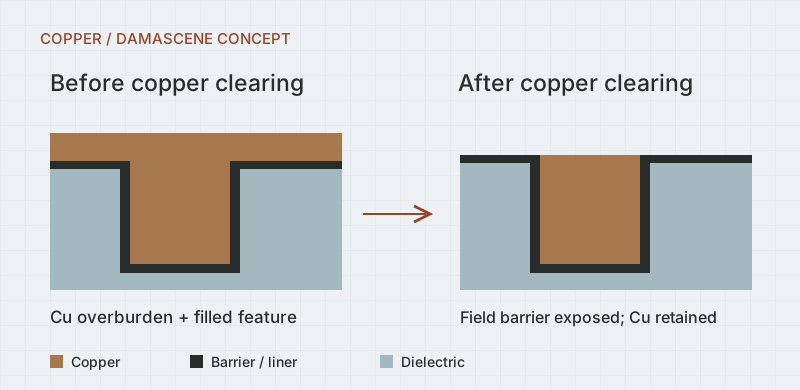
In damascene integration, copper fills patterned features and leaves an overburden that must be removed. Bulk copper removal and the subsequent barrier step solve different problems. FUJIFILM’s published portfolio explicitly distinguishes copper overfill removal from barrier removal after copper clearing. Manufacturer application descriptions ↗
An RFQ should identify the stage, overburden condition, barrier or liner, dielectric and patterned geometry. “Copper slurry” does not say whether the product must maximize bulk throughput, approach a stopping layer or protect exposed lines during a later polish.
Oxidation, complexation and protection
Published copper CMP studies describe a surface region modified by oxidizers, complexants and inhibitors, followed by removal under mechanical contact. Protection in recessed regions can limit dissolution while contact enables removal from elevated regions. This is a conceptual model, not a disclosed supplier recipe. Tribo-electrochemical review ↗
Complexation helps explain why solution chemistry affects copper removal. Inhibition and passivation introduce surface protection, but they also affect removal and residues. The objective is a controllable balance through the full polish and clean sequence, not maximum chemical aggressiveness.
| Question | Useful evidence | Why it changes selection |
|---|---|---|
| How much copper dissolves without contact? | Static etch / immersion data with conditions and exposure time. | Chemical loss can continue in recesses or during an idle hold. |
| How does the surface behave while sliding? | Polishing results and, where available, dynamic electrochemical evidence. | A protected static coupon may respond differently under contact. |
| What happens at copper clearing? | Patterned-wafer endpoint and overpolish study. | The area exposed to the liquid and the contacted films change. |
| Which residues survive cleaning? | After-clean particle, organic and metal-contamination results. | A good as-polished surface may not be suitable downstream. |
Corrosion and galvanic interactions
Copper and another conductive material can form an electrochemical couple when electrically connected and exposed to the liquid. Whether this causes unacceptable attack depends on the actual pair, chemistry and surface state. Do not generalize from isolated blanket films to a coupled stack.
Recent Cu/Co research distinguishes static electrochemistry from behavior during sliding and reports material-specific inhibition. It supports testing the actual interface; it does not establish one inhibitor as suitable for all metals. Cu/Co dynamic corrosion study ↗
Include start-up, endpoint, overpolish, rinse transition and queue time in the test plan. Ask whether the supplier’s corrosion evidence includes coupled materials and whether it was obtained under static or polishing conditions. For inhibitor-sensitive systems, pH and surface state must travel with the result. Inhibitor surface-state study ↗
Separate dishing from erosion
Dishing is recession within a feature, such as copper in a wide line. Erosion is loss across a patterned region relative to its reference region, involving the combined response of the films and layout. Pattern density, line geometry and polish stage influence the outcome; they are not only slurry properties. Pattern-dependent CMP study ↗
| Risk | Design the observation | Decision to make |
|---|---|---|
| Dishing | Measure feature profiles across widths and overpolish conditions. | Can copper be protected while field material clears? |
| Erosion | Compare dense and sparse regions using agreed reference locations. | Does the film-rate balance preserve the required topography? |
| Pitting / localized corrosion | Inspect after polish, clean and defined holds. | Is the damage chemical, contact-assisted or introduced in cleaning? |
| Scratches / particles | Classify defects and inspect the slurry delivery path. | Does the large-particle population, pad or handling explain the failure? |
| Residue | Measure the surface after the intended cleaning process. | Does removal chemistry create a cleaning burden the platform cannot tolerate? |
A copper-specific qualification sequence
- Screen target and adjacent blanket films using matched point-of-use preparation.
- Record static chemical loss separately from polishing rate.
- Test representative patterned wafers at nominal endpoint and defined overpolish conditions.
- Check copper loss during holds and transition into cleaning.
- Characterize defects after cleaning; document the classification method and inspection threshold.
- Repeat across slurry lots and the planned pad-life range.
- Resolve product changes, shelf-life limits and supply continuity before production release.
Sources & evidence
- Experimental Strategies for Studying Tribo-Electrochemical Aspects of CMP ↗Peer-reviewed review · Lubricants · 2024. Copper surface-film formation, removal and experimental approaches. Indexed publisher excerpts reviewed; direct retrieval rate-limited.
- Corrosion mechanisms of Co and Cu: electrochemistry and triboelectrochemistry ↗Peer-reviewed research · Corrosion Science · 2026. Metal-specific inhibition and the difference between static and sliding conditions. Public abstract reviewed.
- First-principles insight into pH-dependent corrosion inhibition of copper ↗Peer-reviewed modeling study · Corrosion Science · 2024. Surface-state and inhibitor-speciation dependence in the studied copper systems; not a universal pH prescription.
- Coverage Layout Design Rules and Insertion Utilities for CMP-Related Processes ↗Peer-reviewed research · Journal of Low Power Electronics and Applications · 2021. Pattern dependence and staged copper polishing. Indexed publisher excerpts reviewed.
- FUJIFILM Electronic Materials — CMP Slurries ↗Manufacturer primary source. Copper, barrier, cobalt and front-end slurry categories; post-CMP cleaners are separately identified.