 CMP Slurry PROCESS MATERIALS REFERENCE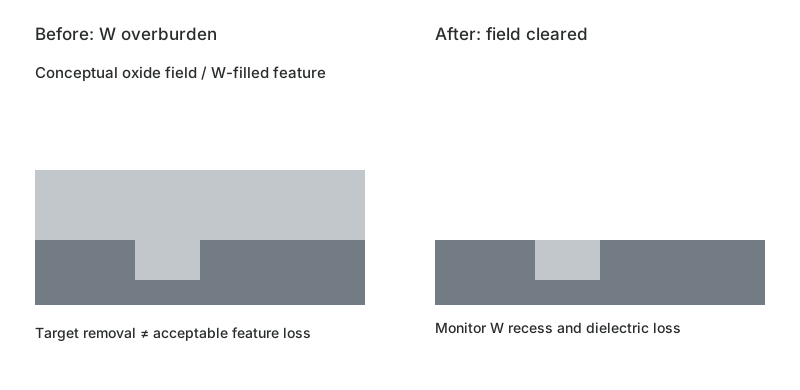
Start with the tungsten integration scheme
Tungsten is used in semiconductor contact and plug structures, among other applications. Specify the deposited film, liner or barrier, surrounding dielectric and clearing objective rather than assuming all tungsten steps have the same rate balance.
A bulk step, a selective clearing step and a buff can require different products. Entegris’s current brochure describes selective, nonselective and buff offerings within its tungsten portfolio. These are supplier-defined options, not evidence that one family is suitable for a particular fab. Disclosed tungsten portfolio ↗
Oxidation does not mean uncontrolled dissolution
In published tungsten mechanisms, oxidizing chemistry produces a modified oxide-containing surface; contact can remove that layer while the reaction layer can also restrict attack of underlying metal. The behavior depends on the liquid and conditions. Tungsten mechanism overview ↗
A study on tungsten dissolution suppression examines coordination chemistry in an oxidizing system. Its result supports treating dissolution and polishing removal as distinct responses; it does not define an appropriate additive or concentration for another process. Tungsten dissolution study ↗
Selectivity and feature recess
| Concern | Evidence to request | Qualification implication |
|---|---|---|
| Tungsten / dielectric balance | Rates for the exact surrounding film, measured under matched conditions. | A nominal “W-to-oxide ratio” is incomplete if the integration uses a different film. |
| Liner / barrier exposure | Removal and chemical-loss data for each exposed layer. | Clearing tungsten does not prove acceptable liner removal. |
| Feature recess | Patterned profiles over feature size and overpolish. | Blanket selectivity cannot predict retained feature height on its own. |
| Residual field tungsten | Endpoint and clearing data across the wafer. | A protective product can still leave incomplete clearing. |
| Surface quality | Roughness, scratches, pits and after-clean contamination. | Separate mechanical defects from chemical loss and residues. |
| Point-of-use aging | Results over the documented preparation-to-use interval. | A stable supplied product need not have the same use-life after activation. |
Abrasive and preparation questions
Silica and alumina are discussed in tungsten CMP literature. Do not derive current product suitability from the abrasive alone. Ask the supplier which particle specification applies to the product and how distribution-tail control is maintained through storage, dilution and delivery.
- Identify whether an oxidizer or activator is supplied separately.
- Confirm preparation order and how prepared material is identified and timed.
- Define allowable point-of-use concentration and the measurement used to control it.
- Review filter compatibility with the actual product, including initial conditioning.
- Agree how residue is measured after the intended clean and how re-deposition is assessed.
Release criteria should reflect the feature
Use separate gates for field clearing, recess, adjacent-film loss and after-clean surface quality. A candidate can pass average rate and fail any of these. Include both center-to-edge behavior and the feature populations that determine device risk.
Record the pad-life range, lots, tools and queue conditions covered by the qualification. If a supplier offers a modified version of the product, compare it against those same gates rather than accepting a statement that the chemistry is “equivalent.”
Sources & evidence
- Suppression of Dissolution Rate via Coordination Complex in Tungsten CMP ↗Peer-reviewed research · Applied Sciences · 2022. Oxidation and dissolution control in the reported tungsten system. Indexed publisher excerpts reviewed; direct retrieval rate-limited.
- Abrasive for Chemical Mechanical Polishing ↗Technical chapter · IntechOpen · 2018. Abrasive roles in metal and dielectric CMP, including tungsten surface oxidation. Historical application statements should not be read as current market facts.
- Entegris — Synergies to Improve CMP Yield brochure ↗Manufacturer brochure · 2026. Disclosed EPOCH, i-Cue, Sentinel, WIN, Semi-Sperse, iDIEL and Novus slurry families.